
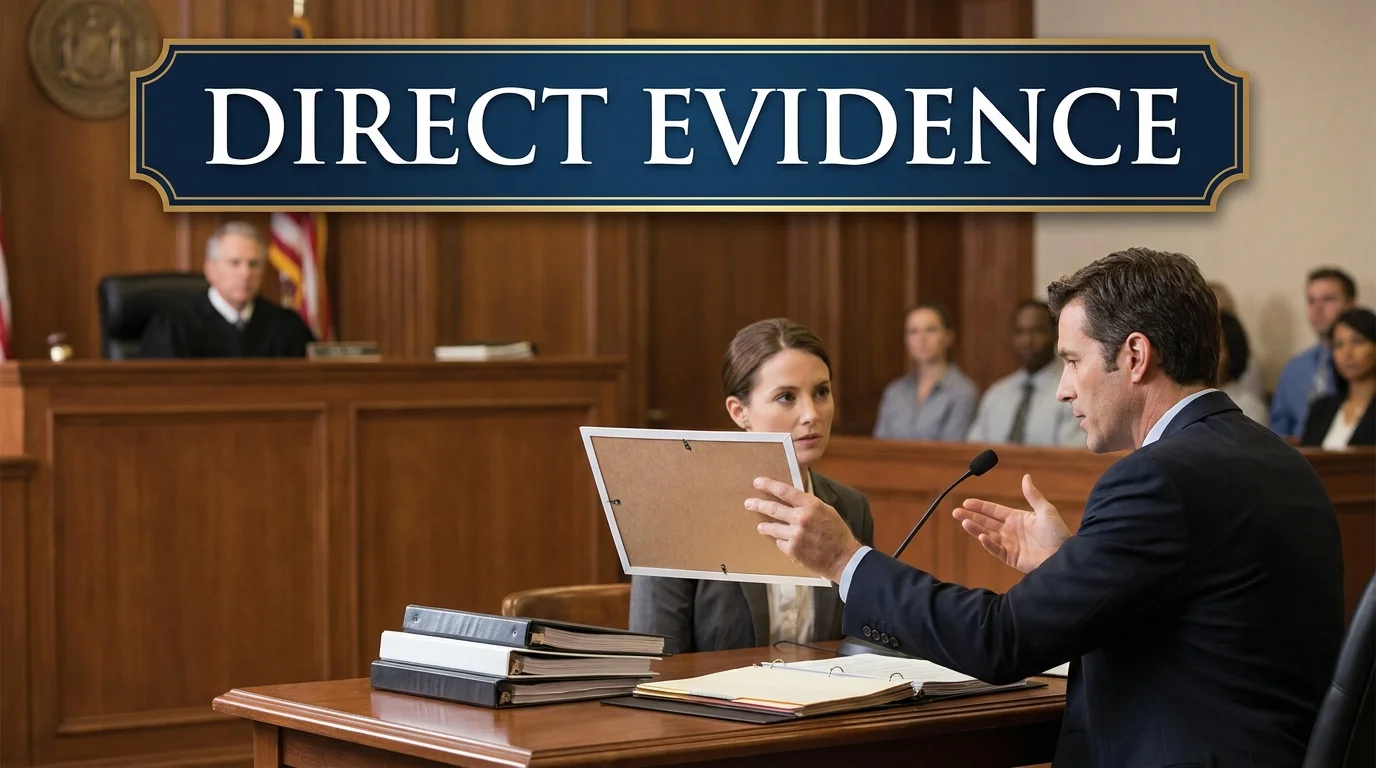
In U.S. law, direct evidence is proof that establishes a fact without requiring a judge or jury to infer that fact from another circumstance. An eyewitness who personally saw an event is the classic example, but recordings, admissions, and documents can also provide direct proof depending on what fact they establish. Understanding the distinction matters because people often assume this type of proof is automatically stronger than circumstantial evidence, which courts do not necessarily treat that way.
| Key Point | What It Means |
|---|---|
| Basic definition | Proof that establishes a fact without an intermediate inference |
| Common example | A witness testifies about something personally seen, heard, or done |
| Main comparison | Circumstantial proof requires an inference from another fact |
| Relative weight | Courts do not automatically give one category greater weight |
| Federal witness rule | A fact witness generally needs personal knowledge |
| Documents and recordings | They may need authentication before admission |
| Criminal and civil cases | Both forms of proof can appear in either type of case |
Direct answer: This type of evidence proves a fact without requiring the fact-finder to infer it from another fact. Common examples include an eyewitness describing what they personally observed, a clear recording of an event, or an admission that establishes the point at issue. Its value still depends on credibility, relevance, and admissibility.
Key Takeaways
- Direct proof establishes the fact at issue without an extra inferential step.
- Eyewitness testimony is the standard example, but it is not the only possible form.
- A video, document, or admission can be direct depending on the specific fact being proved.
- Circumstantial proof is not automatically weaker.
- Relevant proof may still face rules concerning personal knowledge, hearsay, authentication, prejudice, and other limits.
- Whether something is direct or circumstantial depends partly on why it is being offered.
What Makes Evidence Direct?
The simplest test is to ask whether the evidence proves the disputed fact by itself if the fact-finder believes it. The U.S. Department of Justice describes eyewitness testimony about a crime as direct because the person personally observed what happened. Cornell Law School’s Legal Information Institute similarly describes the category as proof that immediately points to the issue being decided.
Consider a robbery case in which a customer testifies, “I saw the defendant take money from the register.” If the testimony is believed, no separate factual step is needed to conclude that the witness observed the taking. The question of whether the witness is accurate or credible is separate from the classification of the testimony.
This distinction is useful across criminal and civil litigation, not only criminal trials. A witness who personally watches someone sign a contract can provide direct proof that the signing occurred, while a party’s recorded statement may directly establish what that person said. Readers building a broader U.S. legal vocabulary may also find MagBuff’s explanation of heir meaning and legal rights useful.
7 Clear Examples in U.S. Legal Contexts
The exact classification of an item can change depending on the fact a party is trying to prove. A recording might directly establish that certain words were spoken while providing only circumstantial support for the speaker’s motive. That fact-specific approach helps prevent misleading labels.
- Eyewitness testimony: A witness testifies that she personally saw a driver run a red light.
- An admission or confession: A defendant makes an admissible statement directly admitting a particular act.
- Video of the event: Authenticated footage clearly records the conduct that the party seeks to prove.
- Audio of a statement: A properly authenticated recording directly establishes that particular words were spoken.
- A signed agreement: A document can directly establish its written terms when the agreement’s existence or content is at issue.
- A witness to a signature: Someone who watched a person sign a document can testify directly about the signing.
- Sensory observation: A witness can testify about something personally seen, heard, smelled, touched, or otherwise perceived when that observation is relevant.
These examples do not mean every eyewitness, recording, confession, or document automatically reaches a jury. Federal evidence rules impose separate requirements for relevance, personal knowledge, hearsay, and authentication. Classification describes the logical relationship between the proof and a fact; admissibility asks whether the court may receive that proof.
Direct Evidence vs. Circumstantial Evidence
The key difference is inference. Direct proof establishes the relevant fact without an intermediate conclusion, while circumstantial proof establishes another fact from which the judge or jury may reasonably infer the disputed fact. Ninth Circuit jury instructions use the same basic distinction and tell jurors that both categories may be considered.
| Feature | Direct Proof | Circumstantial Proof |
|---|---|---|
| Requires an inference? | No intermediate inference for the fact established | Yes |
| Classic example | Witness sees an event occur | Wet umbrella suggests it has been raining |
| Can prove a fact? | Yes | Yes |
| Automatically stronger? | No | No |
| Used in criminal cases? | Yes | Yes |
| Used in civil cases? | Yes | Yes |
Suppose a witness testifies that she looked outside and saw rain falling. That observation directly proves that it was raining at the time she looked. If she instead testifies that people entered the building with wet umbrellas and raincoats, those observations may support an inference that it was raining.
The distinction also explains why fingerprints or DNA are often misunderstood in popular discussions. Such forensic material may strongly connect a person to a location or object, but another step of reasoning may be necessary to conclude that the person committed the charged act. The quality of circumstantial proof can therefore be exceptionally strong even though an inference remains involved.
Is Direct Proof Stronger Than Circumstantial Proof?
Not necessarily, and this is one of the most important misconceptions to correct. Ninth Circuit criminal jury instructions state that the law makes no distinction between the weight given to direct and circumstantial proof, leaving jurors to decide how much weight each item deserves. A compelling collection of indirect facts can be more persuasive than an uncertain eyewitness account.
Eyewitness testimony can be challenged because perception, memory, identification, bias, or viewing conditions may affect reliability. Circumstantial proof can also be challenged when the inference is weak or when the same facts reasonably support a different explanation. The strength of a case therefore depends on the quality, credibility, consistency, and legal sufficiency of the entire record rather than a simple label.
A criminal prosecution also does not inherently require an eyewitness before a conviction is possible. Federal courts instruct juries that either form may be used to prove facts, subject to the applicable burden of proof and evidence rules. MagBuff readers interested in a well-known American courtroom story can also review its background discussion of the O.J. Simpson criminal and civil trials.
Does Direct Proof Automatically Mean Admissible Proof?
No. Calling something direct describes how it proves a fact, but it does not override the rules that determine whether the item is admissible in court. Under Federal Rule of Evidence 401, evidence must have a tendency to make a consequential fact more or less probable, while Rule 402 provides the general framework for admitting relevant evidence subject to other legal restrictions.
Witness testimony also has foundation requirements. Federal Rule of Evidence 602 generally requires a fact witness to have personal knowledge of the matter being described, which fits closely with the classic eyewitness example. A person normally cannot turn secondhand information into personal observation simply by repeating what somebody else said.
Recordings, photographs, messages, and other exhibits may also raise authentication questions. Rule 901 generally requires enough evidence to support a finding that an item is what its proponent claims, and satisfying authentication does not guarantee admission because another rule may still bar the evidence. This is especially relevant for digital files, screenshots, recorded conversations, and similar exhibits.
Direct Proof Is Not the Same as Hearsay
Hearsay and the direct-versus-circumstantial distinction answer different legal questions. Under Federal Rule of Evidence 801, hearsay generally concerns an out-of-court statement offered to prove the truth of what it asserts, while Rule 802 establishes the general rule against admitting hearsay unless another rule or authority allows it. A statement can therefore appear highly specific while still creating a hearsay problem. Elsewhere on the site: Polygamy Meaning.
For example, imagine a witness says, “I saw Alex break the window.” That is testimony based on personal observation. If the witness instead says, “Jordan told me Alex broke the window,” the witness personally heard Jordan’s statement but did not personally observe Alex breaking the window.
Whether Jordan’s statement can be admitted for its truth then requires a separate hearsay analysis. Exceptions, exclusions, party statements, and the purpose for which a statement is offered can change the result. Anyone dealing with a real dispute should therefore avoid treating “direct,” “not hearsay,” and “admissible” as interchangeable labels.
Why the Distinction Matters in Civil and Criminal Cases
Understanding the distinction helps people follow how lawyers construct arguments from different facts. A criminal prosecutor may combine testimony from someone who observed an offense with phone data, forensic material, records, and conduct before or after the event. A civil litigant may combine testimony about what happened with contracts, correspondence, financial records, or surrounding circumstances.
The applicable burden of proof is a separate issue from the category of evidence being used. Criminal cases generally require proof beyond a reasonable doubt, while many civil claims use a preponderance standard, and some proceedings use other standards. The type of proof does not by itself change the governing burden.
U.S. law also varies by jurisdiction and subject matter, so federal rules should not be assumed to answer every state-court question. For related background on the structure of American law, see MagBuff’s guide to the 27 U.S. Constitution amendments. MagBuff also covers an applied state-law topic in its overview of Minnesota child support rules and calculations.
A Simple Way to Classify an Example
Start by identifying the exact fact you need to prove. Then ask whether the offered item establishes that fact immediately if believed, or whether another conclusion must be drawn first. This method is more reliable than memorizing a list of supposedly “direct” objects because the same item can play different roles in different cases.
Take a security video showing a person entering a store at 9:00 p.m. The video may directly prove that the recorded person entered the store at that time, assuming identity and authentication are established. Using the same video to prove that the person later stole an item outside the camera’s view would require additional facts and an inference.
This approach also explains why legal classification can differ from everyday language. People often call compelling scientific or digital proof “direct” because it feels decisive, but legal analysis focuses on whether an inferential step connects the proof to the particular fact at issue. The more precise question is not “How convincing is this?” but “What fact does this item establish without another inference?”
Frequently Asked Questions
What is the easiest example of direct evidence?
The easiest example is an eyewitness who testifies about something the witness personally observed. A witness saying, “I saw the car strike the fence,” directly establishes the witness’s observation if believed. Credibility and admissibility can still be challenged even though the testimony falls into the direct category.
Is direct evidence always eyewitness testimony?
No. Eyewitness testimony is the classic example, but authenticated recordings, admissions, documents, or other exhibits can sometimes directly establish the particular fact in dispute. The classification depends on the fact the item is offered to prove, not the item’s physical form.
Is circumstantial evidence weaker?
No automatic rule makes circumstantial proof weaker. Federal jury instructions explain that both categories can be used to prove facts and that jurors decide the weight each deserves. A consistent group of reliable circumstances may sometimes be more persuasive than a disputed eyewitness account.
Can someone be convicted without an eyewitness?
Yes, a criminal case does not inherently require eyewitness testimony. Courts may consider circumstantial proof, direct proof, or a combination, and the prosecution must satisfy the applicable burden of proof with admissible evidence. The strength of a particular case depends on the complete record rather than whether one specific category is present.
Are photos and videos automatically admissible?
No. A photo or video may need authentication showing that it is what the party claims it is, and other evidentiary rules may still apply. Federal Rule of Evidence 901 addresses authentication, while relevance, hearsay, prejudice, constitutional issues, and other rules can create separate questions.
Is hearsay the opposite of direct proof?
No. Hearsay is a separate doctrine concerning certain out-of-court statements, while the direct-versus-circumstantial distinction concerns whether an inference is required to establish a fact. Mixing these categories can produce incorrect conclusions about whether testimony or an exhibit may be used at trial.
The Bottom Line
The central question is simple: does the proof establish the disputed fact without requiring an intermediate inference? If it does, it generally fits the direct category; if another fact must first be established and then used to infer the disputed fact, the proof is circumstantial. Neither label alone tells you whether evidence is reliable, persuasive, or admissible.
For U.S. readers, the safest approach is to separate classification, admissibility, and weight into three different questions. Federal and state evidence rules, the purpose for which an item is offered, and the circumstances of the case can all affect the final analysis.