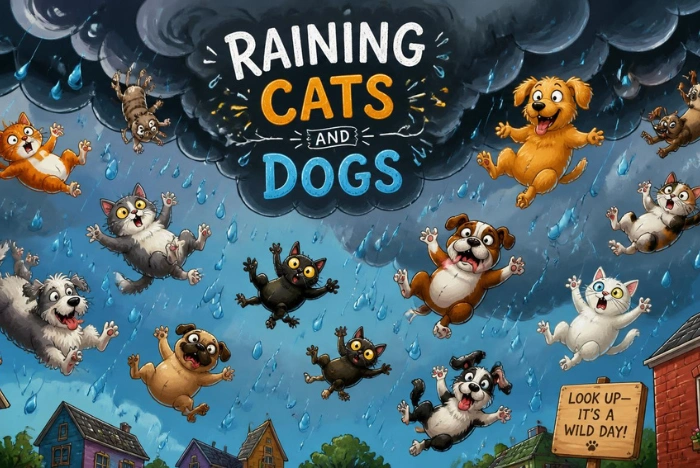
If someone says it is raining cats and dogs, you do not need to look outside for falling pets. The expression simply means that rain is coming down extremely hard. It is one of English’s most memorable weather idioms, and American speakers usually understand it immediately. You might also like Caterwauling.
| Key fact | Quick explanation |
| Meaning | Raining extremely heavily |
| Type of expression | Idiom and figurative exaggeration |
| Literal meaning? | No |
| Earliest documented related wording | 1651 |
| Exact origin | Unknown |
| Common U.S. alternatives | Pouring, coming down hard, coming down in sheets |
| Tone | Informal, colorful, sometimes playful |
| Modern usage | Familiar, though it can sound old-fashioned |
The expression means rain is falling extremely hard, usually in a sudden or sustained downpour. It is figurative, not literal, and speakers use it to emphasize how intense the weather feels. In American English, it is familiar and playful, though alternatives such as “pouring” often sound more natural in everyday speech.
What Does Raining Cats and Dogs Mean?
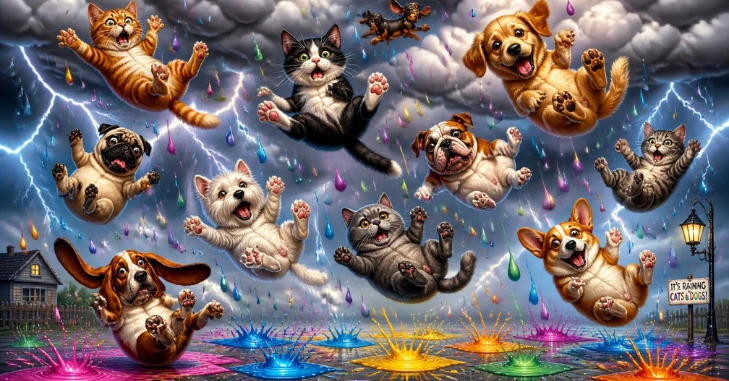
The idiom describes heavy or intense rainfall, not an ordinary shower or light drizzle. Merriam-Webster defines the expression simply as “raining heavily,” while Cambridge gives essentially the same meaning. You would normally save it for weather that makes you reach for an umbrella, cancel outdoor plans, or wait for conditions to improve.
The phrase is also an example of how idioms work differently from literal language. Knowing the individual meanings of “rain,” “cats,” and “dogs” does not tell a learner what the complete expression means. The full phrase has developed a conventional meaning that English speakers recognize without picturing animals dropping from the clouds.
Key Takeaways
- The expression means rain is falling extremely hard.
- It should not be interpreted literally.
- Related versions of the saying have been documented since the 1600s.
- Historians do not know its exact origin.
- Americans generally understand it, although “it’s pouring” often sounds more natural today.
- Several colorful origin stories exist, but none has been conclusively proved.
Where Did This Strange Expression Come From?
The most accurate answer is that nobody knows for certain. The Library of Congress says the expression’s origin remains unknown and lists several theories that have been proposed over time. Raining cats and dogs Phrase Finder reaches the same conclusion, describing the precise source of the seventeenth-century saying as uncertain.
That uncertainty matters because internet explanations often turn guesses into supposed historical facts. A good origin story may sound convincing without having documentary evidence behind it. For this idiom, the surviving written record tells us when similar wording appeared, but it does not reveal why the original speaker chose cats and dogs.
What the Historical Record Can Show
The Library of Congress points to a 1651 poem by Welsh writer Henry Vaughan that referred to “dogs and cats” being rained in a shower. One year later, playwright Richard Brome used a related expression involving “dogs and polecats” in The City Wit. These examples show that the basic image was circulating in English during the seventeenth century.
Jonathan Swift later used the familiar form in 1738, and Merriam-Webster lists 1738 as the first known use of “cats and dogs” in this heavy-rain sense. Swift had also described dead animals being carried through flooded London streets in his 1710 poem A Description of a City Shower. That connection is interesting, but it still does not prove that flooded streets created the idiom.
Popular Origin Theories and What the Evidence Says
Several explanations have survived because each gives the bizarre wording a memorable story. The problem is that none has gained enough historical evidence to become the accepted origin. Treating the theories as possibilities rather than established facts gives readers a more accurate picture.
| Theory | Basic idea | Evidence status |
| Flooded London streets | Heavy rain carried dead animals through dirty streets. | Possible connection, not proved |
| Thatched roofs | Cats and dogs supposedly fell from wet roofs. | Popular story with weak historical support |
| Catadupe | An old word connected with waterfalls may have influenced the phrase. | Proposed but unproved |
| Norse mythology | Dogs, wolves, cats, storms, and supernatural beliefs became connected. | Speculative |
| Deliberate absurdity | The animals were chosen because the image sounds exaggerated and chaotic. | Plausible, but not documented as the source |
The thatched-roof explanation is especially common online. According to this story, animals sheltered inside thatch and were washed from roofs during storms. Reliable discussions of the idiom do not establish this account as historical fact, so it is safer to regard it as folklore rather than the answer.
Why Cats and Dogs?
Part of the expression’s staying power may come from the image itself. Cats and dogs are familiar animals, and combining them with a violent rainstorm creates a scene that is impossible to forget. English already has many animal expressions because familiar creatures make abstract ideas easier to picture.
There may also be no single logical reason behind the choice. Merriam-Webster’s discussion of the expression notes that many explanations have been suggested without producing a definitive solution. An absurd image can survive for centuries simply because speakers find it vivid, useful, and easy to repeat.
For readers who enjoy seeing how ordinary words acquire specialized meanings, Magbuff’s Heir Meaning explainer offers another example. That article shows how context can change the way a familiar-looking English word needs to be understood.
How Americans Use the Idiom Today
In the United States, the expression is generally understood as informal language rather than a technical description of weather. You might hear it during casual conversation, in a story, or when someone wants to make a storm sound dramatic. In a weather report, business document, or emergency alert, clearer terms such as “heavy rain” or “torrential rain” are usually more appropriate.
Tense can change while the meaning stays the same. A person may talk about yesterday’s storm, describe what is happening outside now, or predict tomorrow’s weather. The wording is flexible enough to fit ordinary conversation, but its exaggerated style gives it more personality than a plain meteorological description.
| Situation | Natural example | Intended meaning |
| Current storm | “It’s raining cats and dogs outside, so take an umbrella.” | The rain is extremely heavy. |
| Talking about yesterday | “The rain was so heavy that we stayed inside.” | Conditions were severe. |
| Changing plans | “It’s pouring, so the game may be delayed.” | Heavy rain may disrupt plans. |
| Driving | “The rain is coming down in sheets.” | Visibility may be poor |
| Casual conversation | “It’s really coming down out there.” | The speaker notices strong rainfall. |
Magbuff also covers what heavy weather can do beyond changing your vocabulary. Its article on the impact of weather on roofing and plumbing systems explains practical problems that intense rain and other conditions can create around a home.
Is the Phrase Old-Fashioned?
Cambridge labels the longer form of the expression as old-fashioned, which helps explain why it can sound playful or deliberately colorful today. That does not mean Americans have stopped understanding it. Dictionary.com still records modern examples from major U.S. publications, showing that the phrase remains recognizable in contemporary English.
The distinction is between recognition and everyday preference. Many speakers know exactly what the idiom means but are more likely to say “it’s pouring” during a real storm. Using the older expression can add humor, emphasis, or a slightly theatrical quality to a conversation.
Modern Alternatives for Heavy Rain
If you want language that sounds more natural in everyday American conversation, “it’s pouring” is probably the easiest replacement. “Coming down hard” and “coming down in sheets” also describe strong rainfall without sounding formal. Merriam-Webster’s thesaurus connects the idiom with verbs such as “pour,” “storm,” and “deluge,” although some alternatives fit particular sentences better than others.
| Expression | Tone | Best use |
| It’s pouring. | Very natural and informal | Everyday conversation |
| It’s coming down hard. | Casual | Describing strong rain as it happens |
| It’s coming down in sheets. | Vivid | Heavy rain with poor visibility |
| Heavy rain | Neutral | News, forecasts, general writing |
| Torrential rain | Strong and more formal | Severe rainfall |
| A downpour | Neutral and common | A period of intense rain |
Choosing among these phrases depends on your audience. A casual text to a friend can be colorful, while a safety notice should be direct. Good English is not only about knowing what an expression means but also recognizing when its tone fits the situation.
Why Idioms Matter for English Learners
Idioms can be difficult because translating each word separately often produces nonsense. Learning the complete expression as a unit is more useful than trying to discover a literal connection between every word. Context, example sentences, and tone are especially helpful when the history behind a phrase is uncertain.
Learners can use the same method with other vocabulary questions. Start with the plain meaning, check whether the expression is formal or informal, and then look at several natural examples. Magbuff’s broader Education section includes other explainers that can help readers build context around unfamiliar terms.
Understanding figurative language also makes movies, books, social posts, and conversations easier to follow. Cultural expressions often carry extra meaning that a dictionary translation cannot fully show. Magbuff’s discussion of the Friday meme as a cultural phenomenon shows a modern example of familiar ideas developing shared cultural meaning online.
The Simple Takeaway
This centuries-old rain idiom means one thing with confidence: the weather is extremely wet. Its history can be traced through seventeenth- and eighteenth-century writing, but the reason cats and dogs became part of the saying remains uncertain. That mystery is part of what has kept the expression memorable for generations of English speakers.
Use the phrase when you want a colorful, informal way to describe a serious downpour. Use “pouring,” “heavy rain,” or “torrential rain” when clarity and modern tone matter more than personality. For more plain-English explanations and cultural topics, explore Magbuff’s Education and Featured content.
Conclusion
The phrase “raining cats and dogs” remains one of the most recognizable and colorful weather idioms in the English language. Although its meaning is straightforward—it describes very heavy or intense rainfall—the history behind the expression is much less certain. Written examples dating back to the seventeenth century show that similar references to cats, dogs, and heavy rain were already circulating, but no surviving evidence conclusively explains why these particular animals became associated with a powerful downpour.
Several theories attempt to solve the mystery, including stories about flooded streets, thatched roofs, waterfalls, Norse mythology, and deliberate exaggeration. While these explanations are entertaining, they should be treated as theories rather than established facts. The safest historical conclusion is that the exact origin of “raining cats and dogs” remains unknown.
Frequently Asked Questions
Is “raining cats and dogs” still used in the United States?
Yes, most American English speakers will recognize the expression and understand that it refers to heavy rain. It may sound more playful or old-fashioned than “it’s pouring,” especially among younger speakers. That makes it useful for colorful conversation, storytelling, humor, and language lessons.
Did cats and dogs really fall from roofs during storms?
There is no solid evidence that animals falling from thatched roofs created the saying. The story is popular because it offers a simple explanation for an otherwise strange combination of words. Historical sources instead show several competing theories and leave the true origin unresolved.
What is the earliest known version of the expression?
A related wording appears in Henry Vaughan’s 1651 poetry, according to the Library of Congress. Richard Brome used another close version involving dogs and polecats in 1652. The familiar wording became documented later, including a 1738 use associated with Jonathan Swift.
What is the simplest synonym?
“It’s pouring” is one of the clearest everyday American alternatives. You can also say “it’s coming down hard,” “there’s a downpour,” or simply “it’s raining heavily.” The right choice depends on whether you want casual, vivid, or neutral language.
\