
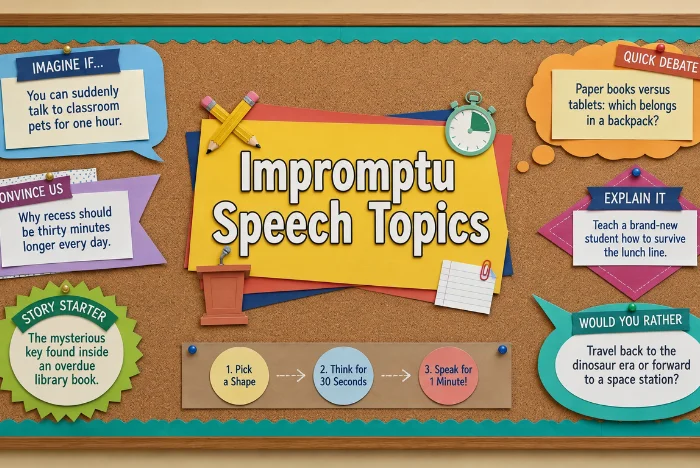
The best impromptu speech topics give you room to form an opinion, tell a story, or explain an idea quickly. Good prompts are clear enough to understand within seconds. They also leave enough freedom for you to make the response personal.
Direct answer: Good impromptu topics include personal experiences, funny situations, school debates, workplace questions, persuasive issues, and abstract ideas. Choose a prompt you can understand quickly. Then organize one main point, one reason, and one example before closing clearly.
| Quick fact | What to know |
|---|---|
| Best practice length | About 1–2 minutes |
| Preparation time | Usually a few seconds to about 30 seconds |
| Useful structure | Point, Reason, Example, Point |
| Beginner topics | Personal experiences and familiar choices |
| Harder topics | Persuasive, abstract, and current-issue prompts |
| Best practice method | Pick randomly, time yourself, and review your answer |
Toastmasters describes Table Topics as practice for organizing thoughts quickly and responding without advance preparation. Responses typically last one to two minutes. That makes short, focused prompts ideal for regular speaking practice.
Key Takeaways
- Start with familiar subjects before moving to abstract or persuasive prompts.
- Build each response around one main idea instead of several weak ideas.
- Use personal examples when possible because they are easier to explain naturally.
- Practice with a timer so you learn how much content fits into one or two minutes.
- Record occasional attempts and listen for filler words, rushed pacing, or weak endings.
- Mix classroom, workplace, humorous, and opinion prompts to build flexible speaking skills.
120 Impromptu Speech Topics to Practice
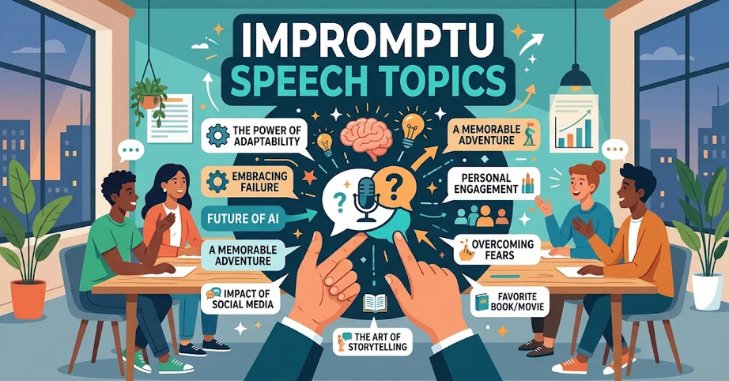
The following impromptu speech topics are grouped by purpose and difficulty. You can use them for classrooms, speech clubs, interviews, team activities, or individual practice. Pick one without planning ahead if you want a realistic exercise.
Easy Topics for Beginners
These prompts work well because they draw on experiences you already understand. You do not need research before answering them. Focus on telling one clear story or explaining one preference.
- What is your favorite way to spend a Saturday?
- Which season do you enjoy most?
- What is one skill you want to learn?
- Describe your perfect breakfast.
- What makes someone a good friend?
- Which school subject is most useful?
- What is your favorite family tradition?
- Describe a place where you feel comfortable.
- What is the best advice you have received?
- Which app do you use most often?
- What hobby would you like to try?
- Describe a memorable road trip.
- What makes a good teacher?
- Which meal could you eat every week?
- What small habit improves your day?
Funny Impromptu Topics
Humorous prompts reduce pressure and encourage creative thinking. They work especially well during classroom warm-ups or speaking-club meetings. You can exaggerate, tell a story, or defend a ridiculous opinion.
- Why Mondays should be three hours shorter.
- Convince everyone that socks and sandals look great.
- Explain why your pet should become president.
- What would happen if phones could complain?
- Defend pineapple on pizza.
- Give an acceptance speech for the world’s messiest desk.
- Explain why naps should count as exercise.
- Sell the audience an invisible umbrella.
- Describe the worst superhero power possible.
- What would your refrigerator say about you?
- Explain why aliens avoid Earth.
- Invent a new national holiday.
- Describe your life as a movie trailer.
- Argue that dessert should come before dinner.
- Explain why your alarm clock is your enemy.
Humor also becomes easier when the subject connects with something familiar. Magbuff’s coverage of the Friday meme and its cultural appeal offers one example of how everyday experiences become shared jokes. A simple observation can often support an entertaining one-minute talk.
Topics for Students and Classrooms
Student prompts should encourage opinions without requiring specialized knowledge. They can also help teachers practice reasoning, organization, and respectful disagreement. Older students can add evidence or examples to strengthen each answer.
- Should students have homework every night?
- Should schools start later in the morning?
- Are group projects useful?
- Should phones be allowed during class?
- What makes a school successful?
- Should financial literacy be required?
- Are grades the best measure of learning?
- Should students wear school uniforms?
- Which subject deserves more classroom time?
- Should schools teach basic cooking?
- Is online learning as effective as classroom learning?
- Should students receive less homework on weekends?
- What makes a good class president?
- Should every student learn public speaking?
- What should schools teach about artificial intelligence?
These questions work because students usually have direct experience with the subject. That experience gives them examples without requiring preparation. A speaker can still practice making a structured argument instead of giving a quick opinion.
Persuasive Speech Prompts
Persuasive prompts require you to choose a position and defend it. Avoid trying to cover every possible argument in a short response. One strong reason with a specific example usually works better.
- Should the United States adopt the metric system?
- Should college tuition be lower?
- Should social media platforms have stronger age limits?
- Should public transportation receive more funding?
- Should every worker receive paid family leave?
- Should schools limit student screen time?
- Should voting day be a federal holiday?
- Should cities create more car-free areas?
- Should high schools require community service?
- Should companies test four-day workweeks?
- Should artificial intelligence tools be allowed in classrooms?
- Should professional athletes be considered role models?
- Should public libraries receive more funding?
- Should financial education start in middle school?
- Should restaurants display more nutrition information?
Civic topics can become stronger when you understand the underlying issue before practicing. For constitutional subjects, Magbuff’s guide to all 27 U.S. Constitution amendments provides useful background. Research is especially important when you move from practice prompts to formal debates.
Workplace and Interview Topics
Unplanned speaking is common at work, even when nobody calls it a speech. A manager may request a project update or ask for your opinion during a meeting. Interviewers can also ask questions that require an organized response without preparation.
- Describe a project you are proud of.
- What makes a productive meeting?
- How do you handle competing deadlines?
- Describe a time you changed your mind.
- What makes a strong team?
- How should coworkers handle disagreement?
- What does good customer service mean?
- How would you improve workplace communication?
- What should a manager do after a mistake?
- Describe a lesson you learned from failure.
- How do you prioritize urgent tasks?
- What makes feedback useful?
- Should employees work remotely more often?
- How would you welcome a new teammate?
- What makes someone a good leader?
These prompts also help with concise professional communication. Try answering as though a manager has given you only one minute. Your goal should be clarity, not a perfect performance.
One-Minute Speech Topics
One-minute prompts force you to remove unnecessary details. Choose one message before you begin speaking. Finish while the audience still understands exactly what you wanted to say.
- The value of a good night’s sleep.
- Why curiosity matters.
- A book worth recommending.
- The value of being on time.
- A habit you want to change.
- Why everyone needs a hobby.
- The importance of listening.
- A person who inspires you.
- What success means to you.
- The value of volunteering.
- Why mistakes can be useful.
- Your ideal weekend.
- The importance of exercise.
- A technology you appreciate.
- One thing you would change about your hometown.
Abstract and Challenging Topics
Abstract prompts require you to create meaning from a broad word or idea. Start by deciding what the word represents to you. Then connect that interpretation with one concrete story or example.
- Silence.
- Courage.
- Second chances.
- Time.
- Freedom.
- Balance.
- Home.
- Change.
- Trust.
- Opportunity.
- Responsibility.
- Competition.
- Patience.
- Luck.
- Progress.
Idioms can provide similar practice because they force you to move between literal and figurative ideas. For example, Magbuff explains the meaning and American usage of “raining cats and dogs”. Expressions like that can become creative starting points for short speeches.
U.S.-Focused Debate and Current-Issue Prompts
These prompts suit high school, college, debate-club, and adult speaking practice. Check current facts before presenting any response as authoritative. Policies and public debates can change faster than general speaking techniques.
- Should the voting age remain 18?
- Should community college be tuition-free?
- Should cities expand protected bike lanes?
- Should schools restrict smartphone use?
- Should Congress have term limits?
- Should national parks limit visitors during busy periods?
- Should high schools require a personal-finance course?
- Should remote work remain a standard option?
- Should social platforms label AI-generated content?
- Should public schools offer free breakfast to every student?
- Should college admissions rely less on standardized testing?
- Should cities charge drivers to enter congested downtown areas?
- Should schools teach media literacy as a required subject?
- Should employers publish salary ranges in job listings?
- Should students learn how local government works?
How to Answer an Impromptu Topic Without Freezing
A simple structure gives your mind somewhere to go after hearing a question. One useful framework is PREP, meaning Point, Reason, Example, and Point again. Toastmasters materials have also recommended this structure for spontaneous answers.
- Point: State your answer or position clearly.
- Reason: Explain why you believe it.
- Example: Give one story, observation, or supporting fact.
- Point: Return to your main idea and finish decisively.
Suppose the prompt asks whether every student should learn public speaking. You might say the skill builds confidence because students must explain ideas clearly. Then give an example from presentations, interviews, or classroom discussions before restating your position.
A Simple Practice Routine
Random practice works better than choosing only comfortable questions. Put several prompts into a document, shuffle them, and reveal one at a time. Give yourself about 15 to 30 seconds before speaking.
Start with a one-minute timer and increase the length after your answers become organized. Record one or two attempts each week instead of recording every session. Listening afterward can reveal repeated filler words and rushed transitions.
Change the type of prompt during each session. You might answer one personal question, one persuasive question, and one abstract word. This prevents you from memorizing a single response style.
Common Mistakes to Avoid
The first common mistake is trying to make three or four major points. Short speeches rarely provide enough time to develop them well. Choose one idea and make it memorable.
Another mistake is apologizing before you begin. Saying that you are nervous or unprepared wastes valuable time. Start with your actual point and let the response develop.
Speakers also tend to keep talking because they have not planned an ending. Decide how you will close while you organize your first point. A short speech with a clear ending sounds more confident than a longer response that fades away.
Start With One Topic Today
You do not need a formal speech class to improve spontaneous speaking. Choose one prompt, take a few seconds to organize your response, and speak for one minute. Repeat the exercise regularly and focus on one improvement each time.
The goal is not to sound perfectly rehearsed. The goal is to organize an idea quickly and communicate it clearly. That skill carries into classrooms, interviews, meetings, presentations, and everyday conversations.
Frequently Asked Questions
What are good impromptu speech topics for beginners?
Good beginner topics involve familiar experiences, preferences, and everyday choices. Examples include favorite foods, hobbies, school subjects, travel, friendships, and daily routines. Familiarity leaves more mental energy for organizing your answer.
How long should an impromptu speech be?
There is no universal length for every classroom or event. Toastmasters Table Topics responses typically run from one to two minutes. For home practice, starting with 60 seconds is a practical choice.
How much preparation time should I take?
For practice, give yourself about 15 to 30 seconds after seeing the prompt. That is enough time to choose a main point and example. Reduce the preparation period as your confidence improves.
What is the easiest structure to remember?
PREP is one of the easiest frameworks because it has only four parts. State your point, give a reason, provide an example, and repeat the main point. The structure works particularly well for opinion questions.
How can students practice impromptu speaking?
Students can practice in pairs, small groups, or individually with a timer. One person can choose a random prompt while another responds for one minute. Brief feedback should focus on organization, clarity, pace, and the ending.
How do I choose impromptu speech topics for a group?
Choose prompts that participants can understand without specialized knowledge. Mix personal, funny, persuasive, and imaginative questions so different speakers have opportunities to succeed. Avoid sensitive personal questions unless the group has clearly agreed to them.