
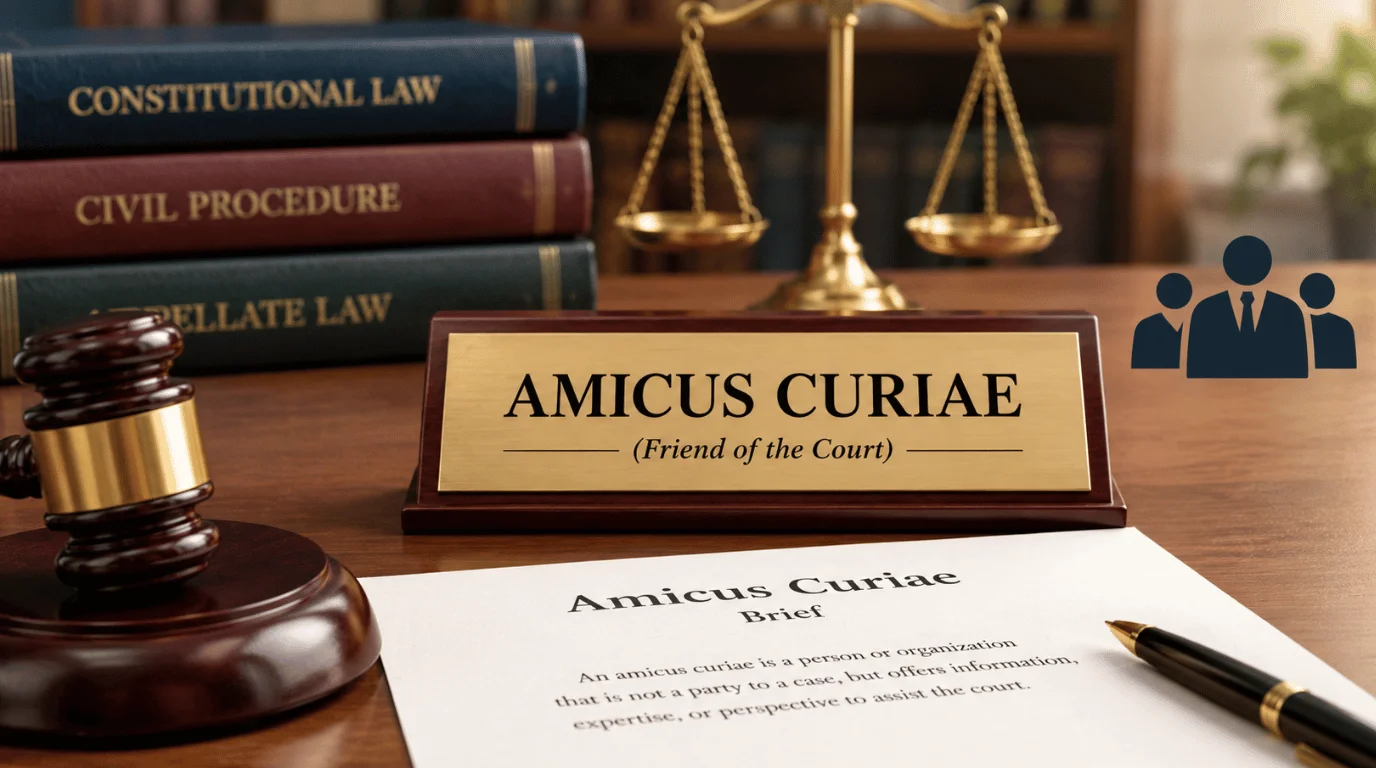
An amicus curiae is a person or organization that offers information to a court without being a party. The Latin term means “friend of the court.” In the United States, amici often submit briefs addressing legal arguments, broader consequences, specialized knowledge, or relevant facts.
An amicus does not become a plaintiff or defendant merely by filing a brief. The court also remains free to accept or reject the arguments presented. Rules governing these filings differ between courts and stages of litigation.
| Key Point | What It Means |
|---|---|
| Literal meaning | “Friend of the court” |
| Role | Offers relevant information or legal arguments |
| Party to the lawsuit? | No |
| Common filing | Amicus brief |
| Common users | Governments, nonprofits, businesses, academics, trade groups |
| U.S. Supreme Court rule | Supreme Court Rule 37 |
| Federal appellate rule | Federal Rule of Appellate Procedure 29 |
| Controls the case? | No |
| Can influence a decision? | Potentially, but the court decides what weight to give the filing. |
Direct answer: An amicus is a nonparty that provides a court with relevant information, arguments, or perspectives. In U.S. appellate litigation, this usually happens through an amicus brief. Such briefs can identify legal issues or consequences the parties have not fully addressed, but amici do not control the lawsuit.
Key Takeaways
- An amicus is usually not a party to the dispute.
- An amicus brief should add useful material rather than repeat party arguments.
- Governments and private organizations may face different filing requirements.
- Supreme Court practice is primarily governed by Rule 37.
- Federal appellate practice is governed by Federal Rule of Appellate Procedure 29.
- Courts decide whether an amicus filing deserves consideration or weight.
- Filing requirements can differ among federal and state courts.
What Is an Amicus Curiae?
The term describes an outsider who provides assistance to a court considering a legal dispute. That assistance commonly arrives through a written brief. The filing may explain legal doctrine, provide specialized context, or discuss consequences extending beyond the immediate parties.
The role differs from ordinary participation in litigation. A plaintiff brings a claim, while a defendant responds to one. An amicus normally enters the discussion without acquiring those same procedural rights or responsibilities.
The U.S. Supreme Court describes useful amicus briefs in practical terms. Rule 37 favors filings that bring relevant matters not already presented by the parties. The rule says filings that fail to serve that purpose can burden the court.
What Does an Amicus Do?
An amicus typically tries to help judges understand an issue affecting the case. The filing may present an argument the parties overlooked. It can also explain technical, economic, historical, scientific, or industry context relevant to the dispute.
The value comes from adding something useful to the record before the court. Repeating a party’s arguments offers much less assistance. Federal appellate rules therefore focus on the amicus’s interest and the usefulness of its perspective.
An amicus can support one side or sometimes support neither side. Supporting a party does not transform the filer into that party’s lawyer. The judges still independently evaluate the arguments and governing law.
What Is an Amicus Brief?

An amicus brief is the written document through which an amicus presents its position. These briefs appear frequently in appellate litigation because appeals often address significant legal questions. Some cases can affect industries, government programs, constitutional rights, or future lawsuits beyond the named parties.
The brief generally identifies the filer and explains its interest in the dispute. It then develops the legal or factual points the filer believes will help the court. Applicable procedural rules determine additional content, timing, disclosure, and formatting requirements.
Federal appellate procedure provides an example. Rule 29 requires specified information concerning the amicus’s identity, experience, interests, and helpful perspective. The precise requirements depend on the court and procedural stage.
Amicus vs. a Party to the Case
Understanding the distinction between an amicus and a litigant prevents a common misconception. A party has a direct procedural position in the lawsuit. An amicus generally participates in a narrower supporting capacity.
| Feature | Amicus | Party |
|---|---|---|
| Named plaintiff or defendant | Usually no | Yes |
| Directly controls litigation | No | Often has substantial control |
| Files an amicus brief | Yes | No |
| Files principal party briefs | Generally no | Yes |
| May offer outside perspective | Common purpose | Focuses on party’s position |
| Automatically participates in oral argument | No | Subject to normal court procedures |
| Bound by filing rules | Yes | Yes, under different provisions |
The distinction matters because an amicus cannot ordinarily take over the case. It cannot simply replace the parties’ claims with different ones. Its role centers on assisting the court within the applicable procedural boundaries.
Readers learning U.S. legal concepts may also benefit from MagBuff’s guide to direct evidence. That guide explains another frequently misunderstood courtroom term. Keeping procedural roles and evidence concepts separate makes legal cases easier to follow.
Who Can File an Amicus Brief?
Government bodies are prominent amicus participants in American courts. Private organizations, professional associations, advocacy groups, companies, academics, and other interested persons may also seek to participate. The exact filing route depends on the court involved.
Federal appellate rules give certain government filers special treatment. The United States, its officers or agencies, and states can file under circumstances specified by Rule 29. Other amici generally must satisfy the rule’s requirements for private filings.
The Supreme Court has its own procedural requirements under Rule 37. Anyone considering a real filing should therefore check the current rules for that specific court. State appellate courts may use separate rules and deadlines.
Amicus Participation in the U.S. Supreme Court
Amicus participation is especially visible at the Supreme Court because its cases can shape federal law nationwide. Organizations may want the justices to consider consequences extending beyond two litigants. Those consequences can involve constitutional doctrine, regulatory systems, commerce, technology, or other national issues.
Supreme Court Rule 37 specifically addresses briefs filed by amici. Its stated purpose emphasizes relevant material not already brought to the Court’s attention. That principle helps explain why useful filings often offer distinct expertise or arguments.
Research also indicates that amicus submissions can contribute to Supreme Court opinions. A 2024 Law & Society Review study examined language from such briefs appearing in majority opinions. The researchers found several factors associated with the Court’s use of amicus language.
MagBuff’s overview of the 27 U.S. Constitution amendments provides useful background for readers encountering constitutional litigation. Many major Supreme Court disputes concern constitutional provisions or their interpretation. Understanding those provisions can make appellate arguments easier to place in context.
How Federal Appeals Courts Handle Amicus Briefs
Federal Rule of Appellate Procedure 29 governs amicus filings in federal courts of appeals. It addresses filings during consideration of a case on the merits. It also contains provisions concerning rehearing proceedings.
Under Rule 29, specified government entities receive particular filing authority. Other amici may need consent or permission depending on the procedural situation. A motion for permission must explain the movant’s interest and why the proposed filing would help.
Oral argument is another important distinction. Filing a brief does not automatically give an amicus speaking time before the judges. Rule 29 provides that an amicus may participate in oral argument only with the court’s permission.
Why Courts Accept Amicus Briefs
Courts sometimes face questions whose consequences reach beyond the immediate dispute. The parties may understandably focus on winning their own case. An outside filer can provide a wider perspective without changing who the actual litigants are.
Technical expertise can also matter. A medical organization might explain relevant professional practices in an appropriate case. An industry association could describe operational effects connected to a disputed legal rule.
Historical or institutional context can provide another contribution. An amicus might discuss precedent or explain how a rule functions outside the immediate dispute. The usefulness still depends on relevance, accuracy, and the court’s procedural rules.
Can an Amicus Brief Influence a Court’s Decision?
An amicus brief can potentially influence judicial reasoning, but filing one provides no guarantee. Judges determine which arguments deserve weight. They can accept an argument, reject it, or decide it does not affect the outcome.
Academic research provides evidence that some briefs influence opinion content. The 2024 study by Paul M. Collins Jr., Pamela C. Corley, and Jesse Hamner examined Supreme Court majority opinions. It found that factors including argument quality were associated with language adoption from amicus briefs.
That finding should not be interpreted as automatic influence. Courts receive briefs presenting competing views in significant cases. The governing law and record remain central to judicial decisions.
Why Amicus Briefs Matter Beyond One Lawsuit
Appellate decisions can create precedent affecting future disputes. This gives outside organizations a reason to participate when a legal question touches their members or institutional interests. Their concern may extend far beyond the specific plaintiff and defendant.
Consider a case involving how a federal statute applies to a new technology. The parties may focus on their particular dispute. An industry group could explain how competing interpretations might operate across thousands of transactions.
That broader perspective can help judges understand practical consequences. It does not determine the legal result by itself. Instead, it gives the court additional material to evaluate alongside party briefs, precedent, statutes, and the record.
Does an Amicus Have to Be Neutral?
No. The phrase “friend of the court” can sound like the filer must remain neutral. Modern amicus practice frequently involves briefs supporting a particular side.
An amicus can advocate for an outcome while still aiming to provide useful material. Court rules commonly require the filing to identify which party it supports, when applicable. That disclosure helps judges understand the position behind the arguments.
Some amici support neither party. Such a filing may focus on a legal principle or alternative reasoning. The procedural requirements still depend on the particular court.
Amicus vs. Expert Witness
An amicus should not be confused with an expert witness. An expert witness provides evidence or opinions under evidence and procedural rules. The witness operates within the evidentiary process of the case.
An amicus usually presents arguments or contextual material through appellate briefing. The amicus does not become a witness simply because it has expertise. These roles involve different rules and different functions.
The difference becomes clearer when separating evidence from legal argument. MagBuff’s direct evidence explainer covers how courts classify certain proof. An amicus brief, by contrast, is primarily a form of court advocacy.
Can Anyone Become an Amicus?
Interest in a case alone does not guarantee that someone can file whatever they want. Courts establish rules controlling who may submit briefs and under what conditions. Those requirements protect orderly litigation and reduce unnecessary filings.
At the Supreme Court, Rule 37 governs amicus submissions. Federal appellate courts generally apply Rule 29 alongside any applicable local rules. State courts can establish their own procedures.
People considering an actual filing should consult the current rules and qualified counsel. Deadlines, permissions, disclosures, formatting, and service requirements can be significant. This article provides general information rather than legal advice.
Frequently Asked Questions
What does amicus curiae mean in simple terms?
Amicus curiae means “friend of the court.” It describes a nonparty that offers information or arguments intended to assist a court. The contribution usually comes through an amicus brief in appellate cases.
Is an amicus a lawyer?
Not necessarily. The amicus is the person, organization, government body, or other entity providing the outside perspective. Attorneys usually prepare and file the legal brief under the applicable court rules.
Is an amicus part of the lawsuit?
An amicus generally is not a named party to the lawsuit. Its role is narrower than the role held by plaintiffs or defendants. Filing an amicus brief does not ordinarily provide control over the litigation.
What is the purpose of an amicus brief?
Its purpose is to give the court relevant material that can help resolve the case. Strong briefs may provide legal arguments, specialized knowledge, or broader context. Courts generally have little need for filings that merely duplicate party briefs.
Can an amicus support one side?
Yes. Amici commonly file briefs supporting a petitioner, respondent, appellant, or appellee. They may also support neither side when their focus concerns another legal issue.
Can an amicus speak during oral argument?
Not automatically. In federal appellate courts, an amicus may participate in oral argument only with court permission. Rules and practices can vary by court.
Do judges have to follow an amicus brief?
No. An amicus brief does not bind the judges. The court decides whether its reasoning or information is useful and persuasive.
The Bottom Line
An amicus gives U.S. courts an outside perspective without becoming an ordinary party. Its most familiar tool is the written amicus brief. Effective briefs contribute information, expertise, or legal analysis that can help judges evaluate difficult questions.
The role is especially prominent in appellate courts and the U.S. Supreme Court. Specific filing rules depend on the court, procedural stage, and filer. Anyone involved in an actual case should review current court rules and seek appropriate legal advice.
For more plain-English explanations of American law, explore MagBuff’s U.S. Constitution amendments guide. You can also read its direct evidence guide for another core courtroom concept.
—–