

The word eluding often appears in news reports, sports writing, academic discussions, and everyday conversation, but its meaning changes slightly depending on context. Someone can elude the police, an answer can elude a researcher, or success can elude a team. Understanding these different uses makes the word much easier to recognize and use correctly.
Eluding is the present participle of the verb elude, and it means someone or something is escaping, avoiding, or remaining difficult to grasp. The Cambridge Dictionary recognizes uses involving avoiding capture and being unable to remember or understand something.
Eluding means escaping or avoiding someone or something, or remaining difficult to achieve, understand, remember, or obtain. It is the -ing form of elude. For example, a suspect may be “eluding police,” while a solution that remains difficult to discover may be “eluding researchers.”
| Quick fact | Answer |
|---|---|
| Word | Eluding |
| Base verb | Elude |
| Part of speech | Present participle / -ing form of a verb |
| Pronunciation | ih-LOO-ding |
| Core meaning | Escaping, avoiding, or remaining difficult to grasp |
| Common synonyms | Evading, escaping, avoiding, dodging |
| Common confusion | Eluding vs. alluding |
| Example | “The answer was still eluding her.” |
What Does Eluding Mean?
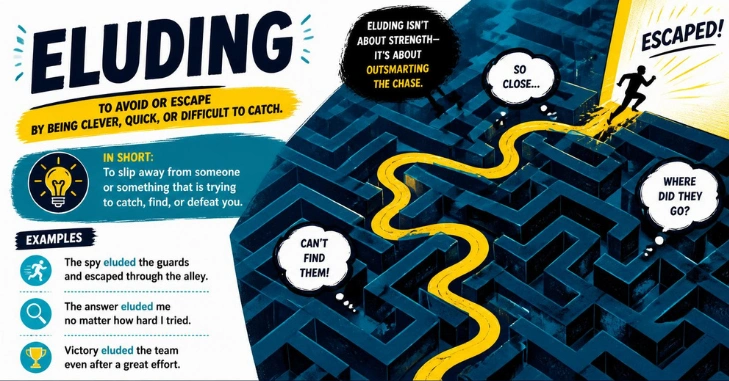
In its most direct sense, eluding means successfully avoiding or escaping from someone or something. For example, a person eludes capture; they have not been caught despite efforts to find or stop them. Merriam-Webster describes elude as avoiding or escaping and also recognizes the broader sense of escaping a person’s understanding or grasp.
The word does not always involve a literal chase or physical escape. People also use eluding when a goal, answer, memory, explanation, or achievement remains just beyond someone’s reach. In a sentence such as “A championship keeps eluding the team,” nobody is physically running away; the team simply hasn’t been able to win the championship.
This figurative use is especially common in journalism, sports coverage, business writing, and academic discussions. Writers may say that a solution is eluding scientists, profitability is eluding a company, or a name is eluding someone’s memory. In each case, the underlying idea remains the same: the desired person, thing, result, or understanding cannot quite be grasped.
How Do You Pronounce Eluding?
In American English, eluding is pronounced approximately ih-LOO-ding, with the strongest emphasis on the second syllable. Its base form, elude, is pronounced /ɪˈluːd/, according to Cambridge and other major dictionaries.
The beginning sounds like the short “i” sound in words such as event when spoken quickly, while the middle contains the long “oo” sound heard in food. Adding the normal -ing ending produces eluding. Saying the word aloud as “ih-LOO-ding” is a useful way to remember both its pronunciation and spelling.
Pronunciation also helps explain why elude and allude are so easy to confuse. They sound very similar in ordinary American speech, although they have different meanings and grammatical patterns. Paying attention to what the sentence describes is therefore more reliable than relying on sound alone.
The Three Main Ways Eluding Is Used
1. Escaping or Avoiding Capture
To capture means someone or something avoiding another person, authority, opponent, or pursuer. A suspect might elude law enforcement, an animal might elude wildlife officers, or an athlete might elude defenders. Cambridge specifically includes avoiding capture: Capturelisheas ans Capturee.
The meaning often suggests that the escape takes speed, skill, or cleverness, and that the pursuer has found the chase difficult. Saying that someone is “eluding police” usually communicates more than simply saying the person is absent. It suggests that efforts to locate or catch that person have been unsuccessful so far.
2. Remaining Difficult to Understand or Remember
Eluding can also describe information that someone cannot understand, identify, remember, or discover. You might recognize an actor but find that the actor’s name eludes you. Similarly, researchers may spend years studying a problem while a complete explanation continues to elude them.
In this sense, what you seek behaves figuratively as though it were escaping the mind. There need not be deliberate avoidance, because an answer, memory, or explanation cannot literally run away. The expression conveys that repeated attempts to grasp something mentally have not succeeded.
3. Remaining Difficult to Achieve or Obtain
A third common meaning involves a desired achievement or result that remains out of reach. A championship can elude an athlete, financial stability can elude a struggling business, or recognition can elude a talented artist. Cambridge gives this failure-to-achieve sense as another standard use of the verb.
This use often appears when someone has actively pursued a goal for a significant period. Writers choose elude because it gives the goal an almost moving quality, as though it keeps slipping away whenever success seems close. That makes the word especially useful in sports and feature writing.
12 Examples of Eluding in a Sentence
- The suspect spent several days eluding police before being arrested.
- The championship has been eluding the team for more than a decade.
- The correct answer was eluding me even though I had studied the topic.
- Sleep kept eluding her before the important job interview.
- The running back was skilled at eluding defenders in open space.
- A permanent solution is still eluding the research team.
- The animal survived for months by eluding attempts to capture it.
- His former teacher’s name was eluding him during the conversation.
- Consistent profitability has been eluding the new company.
- The unusual painting seems to be eluding easy classification.
- The final clue was eluding the detectives until they reviewed the video.
- The forward moved quickly across the field, eluding two defenders before scoring.
These examples show why context matters when determining exactly what the word means in a sentence. Some describe literal avoidance, while others concern goals, memories, answers, or ideas that remain difficult to obtain. The connection is the idea of something repeatedly staying just out of reach.
For another example of Magbuff’s plain-English approach to potentially confusing vocabulary, readers can explore the site’s guide to the meaning of heir. Both words demonstrate how understanding pronunciation, grammar, and context can prevent common writing mistakes. Magbuff’s broader Education section also covers related explanatory topics.
Eluding vs. Alluding: What Is the Difference?
Eluding and alluding sound similar, but you shouldn’t use them interchangeably. Eluding comes from elude and refers to escaping, avoiding, or remaining difficult to grasp. Alluding, on the other hand, comes from allude and means referring to something indirectly rather than naming it directly.
| Word | Meaning | Example |
|---|---|---|
| Eluding | Escaping, avoiding, or remaining out of reach | “The solution is eluding us.” |
| Alluding | Referring indirectly to something | “She was alluding to their earlier disagreement.” |
A particularly common mistake is writing “eluding to” when the writer actually means “alluding to.” If you are making an indirect reference, alluding to is normally the correct expression. Merriam-Webster specifically highlights confusion between these two similar-sounding verbs.
A simple memory trick can help separate them. Think of the E in elude as standing for escape, because something that eludes you escapes you in some physical or figurative way. Think of the A in allude as pointing toward an allusion, which is an indirect reference.
Eluding vs. Evading, Avoiding, and Escaping
Several words can replace eluding in certain sentences, but their shades of meaning are not always identical. Merriam-Webster lists terms such as evading, avoiding, and escaping among related words, along with alternatives such as dodging.
Avoiding is broad and may mean staying away from something, while escaping often focuses on successfully getting free from danger, confinement, or pursuit. Evading often suggests deliberately avoiding someone, a question, a duty, a rule, or an attempt at capture. Capture adds the idea that something is difficult to catch, understand, achieve, or pin down.
Consider the difference between saying “She avoided the question” and “The answer eluded her.” In the first sentence, she may be deliberately choosing not to respond, whereas the second suggests that she genuinely cannot find the answer. Choosing the most precise verb clarifies the intended meaning.
Grammar: Elude, Eludes, Eluded, and Eluding
The base word is elude, and eluding is its -ing form. Standard forms include elude, eludes, eluded, and eluding, which allow the verb to appear in different tenses and constructions. Dictionary.com identifies eluding as the present participle form of elude.
| Form | Example |
|---|---|
| Elude | “The answer may elude us.” |
| Eludes | “The answer still eludes us.” |
| Eluded | “The answer eluded us yesterday.” |
| Eluding | “The answer has been eluding us all week.” |
Elude is generally used as a transitive verb, meaning it normally acts directly on an object. You therefore say that someone eludes capture, CapCaptCaptureicer that an answeCaptueludes capture; grammaticalttern is another reason tha incorrect phrase “eluding to something” should raise suspicion.
Where Does the Word Elude Come From?
The history of elude reaches back to Latin. Merriam-Webster traces it to Latin ēlūdere, carrying ideas such as tricking, avoiding, evading, or making sport of something.
That history fits the modern sense surprisingly well. Something that eludes you appears to slip away just when you try to catch, understand, remember, or achieve it. Knowing this underlying idea can make several apparently different dictionary definitions feel like variations of one concept rather than unrelated meanings.
The related adjective elusive follows the same general idea. An elusive answer is hard to find, an elusive animal is hard to catch, and an elusive goal is hard to achieve. Recognizing this word family can make elude and eluding easier to remember.
Common Mistakes When Using Eluding
The biggest error is confusing eluding with alluding, particularly in the phrase “alluding to.” If a speaker makes an indirect reference to a previous event, the speaker is alluding to it rather than eluding to it. Dictionaries and usage guides consistently distinguish these meanings.
Another mistake is assuming that eluding can describe only criminals or people escaping capture. CaptureCapture Captureord c; Themmoncommonlyes to understanding, memory, achievements, discoveries, and desired results. Restricting it to physical escape overlooks much of the word’s ordinary English usage.
Writers should also avoid forcing eluding into a sentence simply because avoiding would fit. Eluding works best when something seems hard to catch or grasp despite your efforts. When that sense isn’t there, a simpler verb may communicate the idea more naturally.
A Simple Way to Remember the Meaning
Imagine reaching for something that moves away every time your hand gets close. That image works whether the thing is a fleeing person, a forgotten name, a scientific answer, or a long-awaited championship. In every case, what you want is somehow eluding you.
The memory rule “E = escape” makes the distinction even easier. If the sentence involves escaping, evading, slipping away, or staying beyond someone’s grasp, eluding is probably the word you want. If the sentence involves indirectly referring to another idea or event, alluding is usually the better choice.
The Bottom Line
Eluding means escaping, avoiding, or remaining difficult to catch, understand, remember, achieve, or obtain. It is the present participle of elude, and its meaning can be either literal, as in eluding police, or figurative, as in success eluding an athlete. Remembering the central idea of something staying beyond reach makes the different uses easy to connect.
The most important usage mistake to avoid is mixing up eluding and alluding. Use eluding when something escapes or remains beyond your grasp, and use alluding when someone refers to something indirectly. Once that distinction is clear, choosing the correct word becomes much simpler.
Frequently Asked Questions
What does eluding someone mean?
Eluding someone means successfully avoiding, escaping, or staying away from that person despite an attempt to catch, find, or reach them. The phrase is commonly used when discussing police pursuits, searches, sports, and other situations involving active attempts to stop someone. It usually suggests that the person being pursued has remained beyond the pursuer’s reach.
What does “eluding me” mean?
When someone says something is “eluding me,” it usually means they cannot remember, understand, discover, or obtain it. For example, “Her name is eluding me” means the speaker knows the name but cannot remember it at that moment. The phrase can also apply to solutions, explanations, goals, and achievements.
Is eluding the same as avoiding?
The meanings overlap, but they are not always identical. Avoiding is a broad term for staying away from something, whereas eluding often emphasizes successfully escaping or remaining difficult to catch or understand. Someone can deliberately avoid a meeting, for example, but a difficult solution may elude a scientist without any deliberate action.
Is “eluding to” correct?
Usually not, when you mean making an indirect reference. The standard phrase for that idea is “alluding to,” as in “She was alluding to an earlier conversation.” Use eluding instead when you mean escaping, avoiding, or remaining difficult to grasp.
What is a synonym for eluding?
Possible synonyms include evading, escaping, avoiding, dodging, and circumventing, although the best choice depends on the sentence. When eluding refers to a difficult answer or idea, phrases such as “remaining beyond understanding” may communicate the meaning more accurately than a direct synonym. Context should therefore guide the replacement.
What is the opposite of eluding?
The opposite depends on how the word is being used. If someone is eluding capture, the opposite could involve being caught, found, or apprehended; if an answer no longer eludes someone, it may have been understood, discovered, or remembered. No single antonym works perfectly in every context.